
Summary:
If your water bill has crept up for no clear reason, or you’ve noticed a soft, soggy patch in your yard that won’t dry out, you’re probably asking the right question: what’s going on underground? For a lot of Long Island homeowners — especially those in homes built between 1945 and 1975 — the answer has more to do with when your house was built than anything you’ve done wrong. The pipes installed during that era are aging out, and many are doing it quietly, without any dramatic warning. Here’s what’s actually behind it.
Water Main Break Causes: What's Really Going On Underground
The most common assumption is that old pipes fail simply because they’re old. That’s part of it, but age alone isn’t the main driver. The bigger issue is corrosion — and Long Island’s soil conditions make it worse than most places.
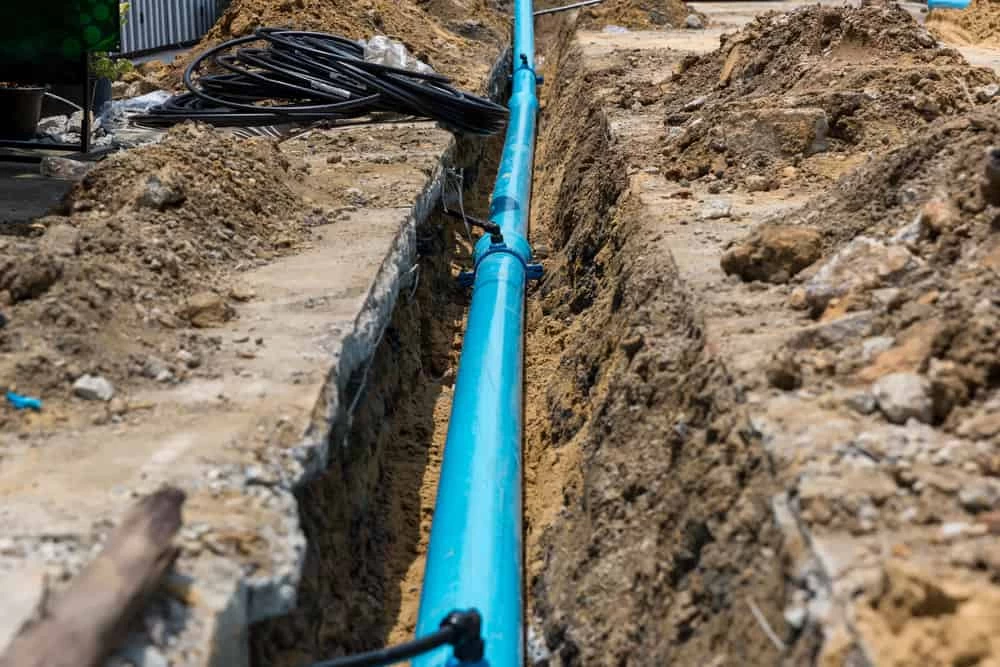
Cast iron pipe, the standard material used in homes built before the late 1960s, has an annual failure rate nearly six times higher than the ductile iron that replaced it. In corrosive soil conditions — which 75% of utilities across the U.S. and Canada report dealing with — that failure rate climbs dramatically. Long Island’s coastal soil, combined with decades of heavy road salting every winter, creates exactly the kind of environment where buried metal pipe deteriorates faster than it would elsewhere in the country. When aging infrastructure reaches the point where replacement is necessary, water main installation can provide a durable solution for restoring reliable water service.
Add in the freeze-thaw cycles that hit Nassau and Suffolk counties hard every winter, and you have a combination of factors that stress aging pipes from multiple directions at once.
Why Cast Iron and Orangeburg Pipe Are Failing Now
If your home was built in Levittown, Bethpage, Massapequa, Hicksville, or any of the hundreds of similar communities that went up across Nassau and western Suffolk County in the late 1940s through the 1960s, there’s a good chance your water service line is made of cast iron — or possibly something even more problematic.
Cast iron was the dominant pipe material of that era, and it’s strong under compression. The problem is that it has no flexibility. When the ground shifts — from frost heave, from nearby construction vibration, from the natural settling that happens over decades — cast iron doesn’t bend. It cracks. And there’s another failure mode that’s even more deceptive: graphitization. As cast iron corrodes, it loses its iron content but retains its shape. The pipe looks intact from the outside. It holds its form. But internally, it’s been hollowed out and replaced with brittle graphite. A pipe in that condition can look perfectly fine right up until the moment it fails.
Orangeburg pipe is a different story entirely. Widely used from the 1940s through the 1960s as a cheaper alternative, it was made from layers of tar paper and pitch pressed together. It was never designed to last more than 50 years. At this point, most Orangeburg pipe is well past that threshold, and it shows — it blisters, it ovalizes, it collapses inward under the weight of soil above it. If your home has Orangeburg and it hasn’t been replaced, it’s not a question of whether it will fail. It’s a question of when.
What makes this particularly relevant on Long Island is the timing. So much of the island’s housing stock was built in a compressed window — essentially the same decade, using the same materials, installed by the same generation of contractors. That means a significant portion of Long Island’s residential underground infrastructure is reaching the end of its design life at roughly the same time. It’s not random. It’s a wave, and it’s been building for years.
How Long Island's Soil and Winters Make Pipe Failure Worse
Long Island’s geology is a product of the last ice age. The soil across most of Nassau and Suffolk counties is sandy and glacially deposited — it drains quickly, which is why the island’s entire drinking water supply depends on underground aquifers rather than rivers or reservoirs. But that same sandy composition means the ground shifts more readily with temperature changes, putting lateral stress on buried pipes that a denser clay soil might absorb.
The coastal proximity makes things worse for buried metal. Chloride ions — from both seawater influence and the road salt applied heavily across Long Island roads every winter — leach into the soil and accelerate the corrosion of cast iron and ductile iron pipes. This isn’t a slow, theoretical process. Studies on water main failure rates show that cast iron pipe in highly corrosive soil conditions breaks at more than 20 times the rate of cast iron in low-corrosion environments. Long Island isn’t a low-corrosion environment.
Then there’s the seasonal stress. Every winter, the ground freezes and thaws — sometimes multiple times in a single week during a typical Long Island February. Each cycle causes the soil to expand and contract, and the pipes buried in it move with it. Cast iron, with no flexibility to speak of, absorbs that stress as internal pressure. Over enough cycles, that’s how cracks start. It’s not one dramatic event. It’s years of small stresses that accumulate until the pipe can’t hold anymore.
The combination of aging materials, corrosive coastal soil, road salt, and freeze-thaw cycling is why we see so many Long Island water main issues in late winter and early spring — right after the ground has been through its hardest months.
Water Pipe Leaks Underground: What They Look Like From Your Yard
Not every water main failure announces itself with a geyser in the street. Most underground leaks in residential service lines are slow and quiet — losing water gradually over weeks or months before anything visible appears on the surface.
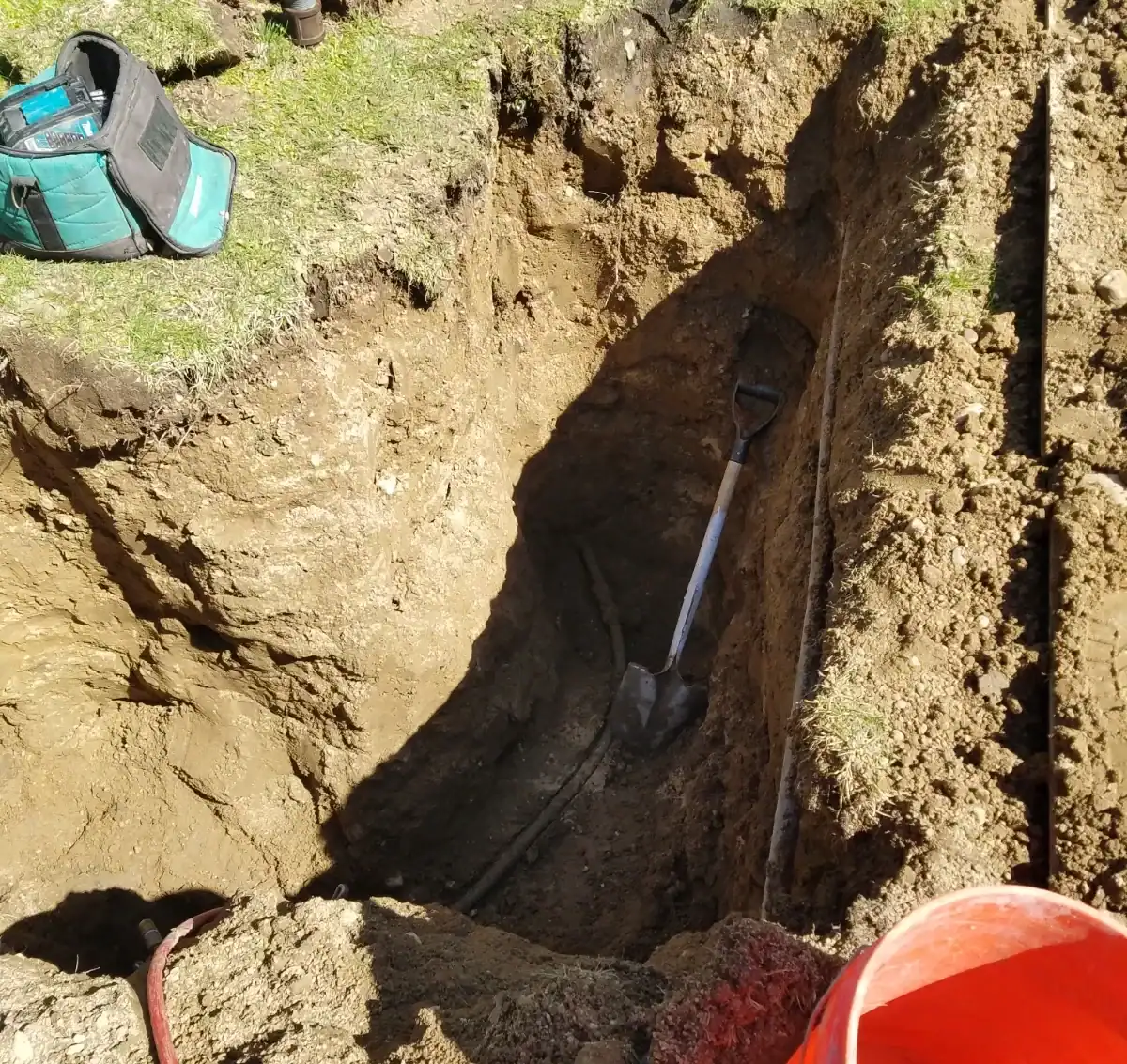
The most common early signs are a water bill that’s higher than it should be with no change in usage, low or inconsistent water pressure, and soft or soggy patches in the yard that don’t dry out after rain has passed. Discolored water — rust-colored or murky — can also indicate a deteriorating pipe. None of these symptoms are dramatic, which is exactly why so many homeowners wait too long. By the time a wet spot becomes obvious, the leak has often been going on for a while.
How to Tell If Your Water Main Is Leaking Underground
The most accessible first check is your water meter. Turn off every water source in the house — faucets, appliances, irrigation — and then look at the meter. If it’s still moving, water is leaving the system somewhere. That doesn’t pinpoint the location, but it confirms a leak is present. It’s a simple test, and it takes about five minutes.
Beyond that, a few other patterns are worth paying attention to. If your pressure has been gradually dropping over the past year, that’s not a coincidence. If one area of your yard stays noticeably greener or softer than the rest — especially along the path where your water line runs from the street — that’s the ground absorbing water it shouldn’t be. If you hear a faint hissing or rushing sound near your water shutoff when nothing is running inside, that’s another indicator.
What these signs have in common is that they’re easy to explain away individually. A high bill could be a dripping faucet. Low pressure could be a partially closed valve. A wet patch could be drainage. The problem is that when all of them are present at the same time, the odds of a coincidence get very small. And the longer an underground leak goes unaddressed, the more soil it erodes, the more it can undermine your foundation, and the more it costs to fix. A slow leak that gets caught early is a manageable repair. The same leak discovered after it’s been running for two years is a much bigger problem.
One thing worth knowing: a general plumber is not always the right call for this kind of diagnosis. Water main issues require camera inspection equipment, pressure testing, and experience with underground line behavior — not just knowledge of what’s inside the house. We’ve had homeowners on Long Island come to us after getting two or three different diagnoses from contractors who weren’t equipped to actually see what was happening underground.
Finding Water Leaks in Underground Pipes: How Professionals Locate Them
Locating leaks in underground water pipes is a different process than most homeowners expect. It’s not guesswork, and it doesn’t require digging up the yard to find out what’s going on. We use a combination of acoustic equipment, pressure testing, and camera inspection to find the problem before anyone picks up a shovel.
Acoustic listening devices work by picking up the sound of water escaping under pressure through a pipe wall. Water moving through a crack or joint gap creates a distinct frequency, and our trained technicians can trace that sound along the pipe’s path to narrow down the location. Correlation technology takes this further — using two sensors placed at different points along the line to triangulate exactly where the leak is originating. The result is a specific location, not an educated guess.
CCTV camera inspection is the other critical tool. A small camera is fed into the pipe and transmits live footage back to the technician — showing the interior condition of the pipe in real time. This is how you find out whether you’re dealing with a single crack, widespread corrosion, root intrusion, or a section of pipe that’s structurally compromised. It’s also how you avoid making the wrong repair. A spot fix on a pipe that’s corroded along its entire length is money spent poorly. Camera inspection tells you the full picture before any decision is made.
We show homeowners what the camera sees. Not a summary, not a verbal description — the actual footage. If there’s a crack, you see the crack. If there’s root intrusion, you see the roots. That transparency matters, especially when you’re being asked to make a significant decision about your property.
For most Long Island homes where the water service line runs under a driveway or landscaped yard, the ability to pinpoint the problem before digging makes a real difference. In many cases, once the leak is located, we can address it without excavating the full line at all — using trenchless methods that require only small access points rather than a trench from the street to the house. Whether that’s pipe lining, pipe bursting, or a targeted spot repair depends on what the inspection reveals.
What Long Island Homeowners Should Do If They Suspect a Water Main Problem
If your home was built between 1945 and 1975 and you’ve never had your water service line inspected, it’s worth knowing what’s down there. Not because something is definitely wrong, but because the materials used during that era have a finite lifespan — and Long Island’s soil conditions, winters, and road salt use put extra pressure on pipes that are already aging.
The warning signs are easy to miss or rationalize individually. A higher water bill, a soft spot in the yard, pressure that’s not quite what it used to be. Taken together, they’re worth investigating before a slow leak becomes an emergency.
We’ve been working on Nassau and Suffolk County water lines for nearly 40 years. If you want to know what’s actually going on under your property, we can show you — on camera, before any work begins, with a written estimate and no obligation to proceed.