

Summary:
If your water bill has crept up without explanation, your pressure has dropped at every faucet, or there’s a patch of your lawn that stays wet no matter how dry the weather gets — your water line is trying to tell you something. On Long Island, where most homes were built during the post-war boom of the 1950s and ’60s, aging underground pipes are one of the most common — and most overlooked — home maintenance issues. The good news is that water line replacement today looks nothing like it did a decade ago. We offer faster, less invasive options, and knowing what to look for puts you ahead of the problem before it becomes a crisis.
Water Main Break Causes: Why Long Island Pipes Fail When They Do
Long Island’s freeze-thaw cycle is one of the harshest conditions underground pipes deal with all year. From January through March, the ground freezes, shifts, and thaws repeatedly — and that movement stresses pipe joints, widens existing cracks, and can split older pipes outright. It’s no coincidence that emergency water main calls spike every late winter across Nassau and Suffolk counties.
But the freeze isn’t the only culprit. Galvanized steel pipes — standard in homes built through the 1960s — have a lifespan of 20 to 50 years. Most of those pipes are now well past it. Corrosion builds up on the inside walls, restricting flow and weakening the pipe structure over time. Combine that with Long Island’s mature tree canopy — roots from trees planted 50 years ago now extend far beyond what’s visible above ground — and you have a recipe for slow, invisible damage that builds for years before it announces itself.
Water Pipe Leaks Underground: The Signs That Show Up Before the Break
Underground leaks rarely announce themselves dramatically. More often, they show up as a collection of small, easy-to-dismiss signals — until one day they’re not so easy to dismiss anymore.
A spike in your water bill is usually the first thing homeowners notice. If your usage hasn’t changed but your bill from the Suffolk County Water Authority or your Nassau district supplier has jumped, that water is going somewhere — and it may be going straight into the ground beneath your yard. Low water pressure at every faucet (not just one) is another strong indicator. When the main service line is compromised, the whole system feels it.
Visible signs in your yard are even more telling. A soft, soggy patch that never quite dries out — especially near the street or along the path from the meter to your house — is a classic sign of an underground leak. So is an unusually green strip of grass in an otherwise dry lawn; the leaking water is essentially fertilizing that section from below. In more advanced cases, you might notice a slight depression or sinkhole forming as the soil erodes around the leak point.
Discolored water — rust-colored or brownish — signals that the pipe interior is corroding. This one matters beyond inconvenience; it’s a water quality issue. And if you’re hearing a faint hissing or rushing sound near your water meter or along the front of your property, that’s worth taking seriously. It’s not always audible, but when it is, it’s a reliable indicator that water is moving where it shouldn’t be.
The tricky part is that none of these signs requires an emergency response on its own. But when two or three of them show up together, it’s time to stop watching and start calling. The longer an underground leak runs, the more it erodes the soil around it — and soil erosion near your foundation is a problem that gets expensive fast.
One of the most common questions homeowners ask is how a plumber even finds a leak that’s buried several feet underground. The answer has changed significantly over the last decade, and it’s one reason professional leak detection is worth calling in before any digging starts.
Acoustic leak detection is the most widely used method. It works by listening for the specific sound frequency that pressurized water makes as it escapes through a crack or joint failure. We use sensitive electronic equipment placed at intervals along the pipe path to pinpoint the leak location with surprising accuracy — often within a foot or two — without disturbing the surface at all.
Ground penetrating radar water leak detection takes things a step further. GPR water leak detection uses radar pulses to create a subsurface image of what’s below ground — pipe location, depth, surrounding soil conditions, and voids created by water erosion. It’s particularly useful on Long Island where rocky outcroppings of schist or granite can make assumptions about pipe depth unreliable. Rocky soil is more common than most homeowners realize, especially in parts of Nassau County and the North Shore of Suffolk, and GPR removes the guesswork.
Pressure testing is another tool in our diagnostic process. By isolating sections of the line and monitoring pressure drop, we can confirm whether a leak exists and roughly where along the run it’s occurring. Combined with a camera inspection — where a small camera is fed through the line to give a real-time view of the pipe interior — a thorough diagnosis can often be completed without a single shovel in the ground.
This matters because the diagnosis determines the fix. A small crack in an otherwise sound copper pipe calls for a different response than a corroded galvanized line that’s failing across its entire length. Skipping the diagnosis and jumping straight to replacement is how homeowners end up paying for more than they needed — or paying for a repair that fails again six months later.
Water Line Replacement Methods: Trenchless vs. Traditional on Long Island
When full replacement is the right call, the method matters — especially on Long Island, where a torn-up front yard in a close-knit neighborhood like Massapequa or Huntington isn’t just an inconvenience. It means disrupting mature landscaping, potentially cracking a driveway, and living with a construction site in front of your home for days.
Traditional excavation — digging a trench the length of the pipe run, removing the old line, and installing a new one — is still the right approach in some situations. But for most residential service line replacements on Long Island, trenchless methods are not only viable, they’re often the better choice on every metric that matters.
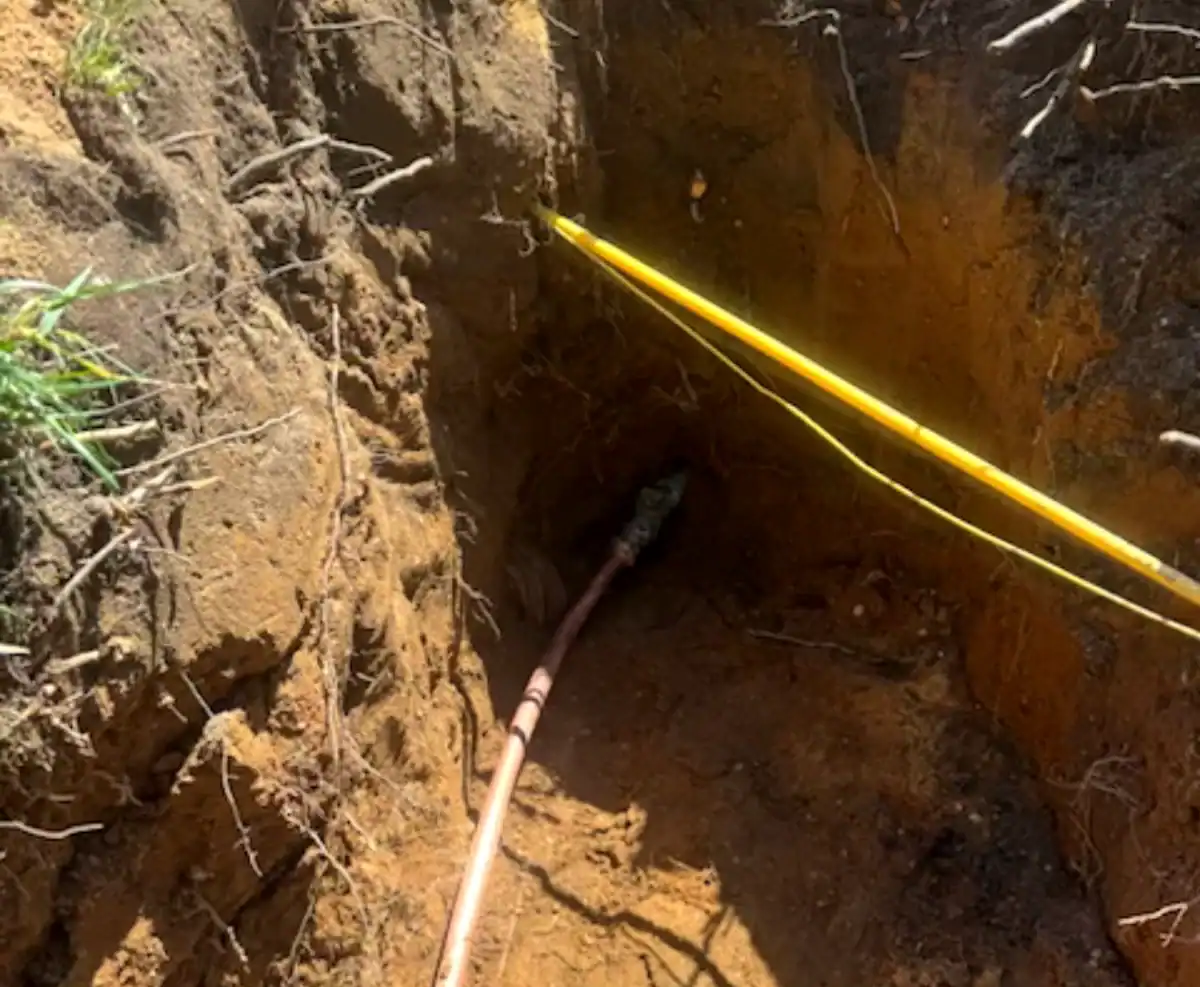
Trenchless Water Line Replacement: Pipe Bursting and Pipe Lining Explained
Trenchless replacement doesn’t mean zero digging — it means minimal digging. Instead of opening a trench the full length of the pipe, we create small access pits at each end of the run. Everything else happens underground.
Pipe bursting is the method we use when the old pipe needs to be replaced entirely. A bursting head is pulled through the existing pipe, fracturing it outward into the surrounding soil while simultaneously pulling a new HDPE pipe into place behind it. High-density polyethylene pipe has a lifespan of up to 100 years and is highly resistant to corrosion and root intrusion — a significant upgrade over the galvanized steel lines it typically replaces in older Long Island homes. The process typically takes a few hours rather than the days that traditional excavation requires.
Pipe lining — also called CIPP, or cured-in-place pipe — is used when the existing pipe structure is still mostly intact but has cracks, joint failures, or minor deterioration. A flexible liner saturated with resin is inserted into the existing pipe and inflated, then cured in place to form a smooth, seamless new pipe inside the old one. It’s particularly effective for sewer lines but is also applicable to water service lines in the right conditions.
Horizontal directional drilling is the third option, used when a new pipe needs to be installed along a path where the existing pipe can’t be used as a guide — or when boring under a driveway, walkway, or other structure is preferable to cutting through it. A drill creates a precise underground bore path, and the new pipe is pulled through. For Long Island properties with long driveways or established hardscaping, this method can save thousands in surface restoration costs alone.
The honest caveat: trenchless isn’t always the right answer. Pipes with severe collapse, significant offset joints, or certain types of damage may not be good candidates for lining or bursting. A proper camera inspection before any work begins is what determines which method is appropriate — not a contractor’s preference or what equipment they happen to have on the truck.
Cost is where most homeowners get stuck, partly because the ranges are genuinely wide and partly because national averages don’t always reflect what things cost here. So let’s be direct about what the numbers actually look like for Nassau and Suffolk county homeowners.
For a water line repair — patching a specific failure point rather than replacing the full run — we typically see costs ranging from $350 to $2,000 depending on depth, access, and the extent of the damage. On Long Island, the per-linear-foot cost for water line work runs between $50 and $250, with the higher end reflecting rocky soil conditions, deep frost-line requirements (New York mandates installation at 42 to 60 inches below grade), or work under driveways and hardscaping.
For a full service line replacement — from the curb stop at the street to the house — expect a range of $2,000 to $5,000 for a straightforward installation, with more complex jobs (long runs, difficult soil, work under existing structures) running $4,000 to $10,000 or more.
A few factors that push costs higher on Long Island specifically: the frost line depth requirement adds installation complexity compared to warmer-climate states; rocky outcroppings in parts of Nassau County and the North Shore can require specialized equipment; and the density of mature landscaping in neighborhoods like Bethpage, Bellmore, or Port Jefferson means surface restoration — replanting, reseeding, repairing irrigation systems — can add meaningful cost to a traditional excavation job. Trenchless methods sidestep most of that restoration cost entirely, which is one reason the total project cost for trenchless is often comparable to or less than traditional excavation once everything is factored in.
One thing worth knowing before you get quotes: on Long Island, water main contractors must hold separate licenses for each township — not just a general New York State license. A contractor without the right township license can’t legally pull permits for your job, which creates legal exposure for you as the homeowner if something goes wrong. It’s worth asking directly.
Underground Leak Detection Services: What We Offer
We’ve been providing leak detection and water line services across Nassau and Suffolk counties since 1980. Our underground leak detection services combine acoustic equipment, pressure testing, and camera inspection to give you a complete picture of what’s happening beneath your property before any work begins.
The goal is simple: pinpoint the problem precisely so the repair or replacement is targeted, not exploratory. We don’t recommend work you don’t need, and we don’t move forward without a clear diagnosis in writing.