
Summary:
You just got the camera inspection results. There’s damage — cracked pipe, root intrusion, a joint that’s shifted — and now someone’s telling you that you need either a trenchless repair or a full excavation. Maybe you’ve gotten two different quotes recommending two different things. That’s more common than you’d think, and it’s exactly why this decision deserves a straight answer. We’ve been doing this work on Long Island for nearly 40 years, and the honest truth is that neither method is right for every situation. Here’s what you actually need to know before you commit to anything.
What Is Trenchless Sewer Repair and How Does It Work?
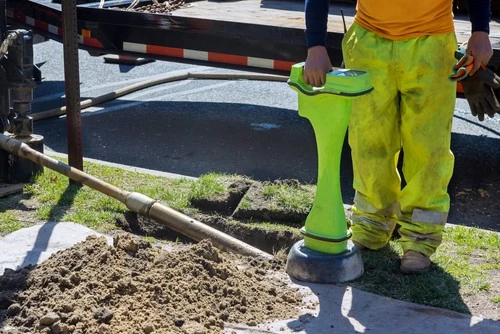
Trenchless sewer repair is exactly what it sounds like — fixing or replacing a damaged sewer line without digging a trench across your property. Instead of excavating down to the pipe, our technicians access it through existing cleanout points and use one of two primary methods: pipe lining or pipe bursting.
Pipe lining involves inserting a resin-saturated liner into the damaged pipe and curing it in place, which creates a new structural pipe inside the old one. Pipe bursting pulls a new pipe through the existing line while simultaneously fracturing the old pipe outward. Both methods require minimal digging — typically just a small access point at each end of the repair zone.
The technology itself isn’t new. CIPP (cured-in-place pipe) lining has been used since 1971, and the first liner ever installed is still functioning today. When it’s done correctly, a properly installed liner carries a 50-year design life — the same standard municipalities use when rehabilitating city sewer mains.
Sewer Pipe Lining: What It's Best For and What to Expect
Pipe lining — also called CIPP lining or sewer pipe lining — works best when the host pipe is structurally compromised but still largely intact. If your camera inspection shows root intrusion, cracking, joint deterioration, or corrosion, but the pipe hasn’t fully collapsed, lining is usually a strong candidate.
Here’s what makes it particularly well-suited to Long Island homes: a large portion of Nassau and Suffolk County’s residential sewer laterals were installed between the 1940s and 1970s, primarily in clay tile or cast iron. Clay tile pipes are especially vulnerable to root intrusion because tree roots actively seek out the moisture at the joints between pipe sections. Once roots get in, they grow, they block flow, and they accelerate structural damage. Lining solves this at the source — the finished liner is seamless and joint-free, which means there’s no longer anything for roots to exploit.
Cast iron pipes face a different set of problems. Over decades, they corrode from the inside out, develop tuberculation (internal rust buildup that restricts flow), and eventually crack under ground movement. A CIPP liner rehabilitates the interior surface and restores structural integrity without requiring the old pipe to be removed.
The installation itself is typically completed in a single day. Our technician cleans the line with a high-pressure water jet first, then inserts the resin-saturated liner, inflates it against the pipe wall, and cures it — either with hot water, UV light, or ambient cure depending on the system being used. Once cured, a post-installation camera inspection confirms the liner is properly seated with no wrinkles, gaps, or defects.
One thing worth knowing: lining preserves the existing pipe’s diameter, which means if your pipe has significant bellying (a low spot where water and debris pool), the belly will still be there after lining. That doesn’t necessarily disqualify lining as an option, but it’s something we’ll discuss with you honestly before recommending it.
Trenchless Pipe Bursting: When a Full Sewer Line Replacement Makes More Sense
Pipe bursting is the trenchless method we use when the pipe needs to be fully replaced rather than rehabilitated. Instead of lining the inside of the old pipe, a bursting head is pulled through it — fracturing the old pipe outward into the surrounding soil while simultaneously pulling a new HDPE pipe into position behind it.
The result is a complete sewer line replacement with no trench running across your property. Access points are needed at each end of the run, but the ground between them stays intact. For a typical residential sewer lateral running from the house to the street, that often means your driveway, lawn, and landscaping are untouched.
Pipe bursting is the right call when the existing pipe is too deteriorated to support a liner — severely cracked sections, significant structural failure, or pipe that has lost too much of its wall integrity. It’s also commonly used when a homeowner wants the peace of mind of a brand-new pipe rather than a rehabilitated one, particularly in older homes where the sewer lateral has never been replaced.
On Long Island, pipe bursting is frequently the right answer for homes in communities like Levittown, Massapequa, and Baldwin — neighborhoods built in the late 1940s and early 1950s where the original clay tile sewer laterals have been in the ground for 70-plus years. At that age, the pipe isn’t just damaged in one spot — the entire line may be at or past its service life, and full replacement is the smarter long-term investment.
It’s also worth noting that pipe bursting can actually upsize the replacement pipe if needed. If your existing lateral is undersized or if flow capacity is a concern, the new HDPE pipe can be installed at a larger diameter — something lining alone cannot achieve.
Trenchless Sewer Repair vs. Traditional Excavation: The Real Cost Comparison
This is where most comparisons go wrong. When people see a per-foot cost for trenchless repair that’s higher than an excavation quote, they assume excavation is cheaper. That’s only true if you’re comparing plumbing costs in isolation — and nobody pays for a sewer repair in isolation.
Excavation quotes cover the plumbing work. They do not cover what happens to everything the trench destroys on the way down. That’s a separate bill — sometimes several of them.
The total cost picture changes significantly once you account for what excavation actually requires. A concrete driveway replacement on Long Island can run $5,000 to $15,000 or more depending on size and finish. Landscaping restoration — especially in communities like Garden City, Rockville Centre, or Oyster Bay where mature plantings and established lawns represent decades of investment — can easily match or exceed the plumbing cost itself. When those numbers are included, trenchless methods typically save homeowners 30 to 50 percent on total project cost.
When Is Trenchless Sewer Repair Not an Option?
This is the question most contractor websites won’t answer directly, because they’re trying to sell you a service. We’d rather give you a straight answer — because the worst thing we can do is recommend a method that isn’t right for your pipe.
Trenchless repair is not appropriate when the pipe has completely collapsed. A liner needs a host pipe to be inserted into, and a bursting head needs a continuous pipe to travel through. If the line has caved in entirely, excavation is the only path forward.
Significant pipe bellying — where a section of the pipe has sunk and created a persistent low spot — is another situation where trenchless alone may not solve the problem. Lining will follow the contour of the existing pipe, which means the belly remains. Depending on how severe it is and whether it’s causing chronic backups, excavation to correct the grade may be necessary either instead of or in addition to lining.
Pipes that have shifted dramatically due to soil movement — particularly in areas with unstable fill or significant frost heave — may also require excavation if the misalignment is severe enough that a liner can’t bridge it cleanly. Long Island’s freeze-thaw cycles, which run from roughly December through March, cause real ground movement every year. In older neighborhoods with clay tile pipes, that seasonal stress accumulates over decades and can create offset joints that are too severe for trenchless methods to address.
Finally, if local regulations or permit requirements in your specific municipality mandate full excavation for a particular repair type, that takes precedence regardless of what the pipe condition would otherwise support. We’ve been working in Nassau and Suffolk counties long enough to know the local regulatory landscape — which is something worth asking any contractor about before they start the job.
The bottom line: a camera inspection is what tells you which method is appropriate. Anyone recommending trenchless — or excavation — without running a camera first is guessing. And guessing with your sewer line is expensive.
Trenchless Sewer Line Replacement on Long Island: What Makes This Market Different
Long Island isn’t a generic suburban market, and the sewer problems here aren’t generic either. The combination of aging infrastructure, mature landscaping, and real winters creates a specific set of conditions that shapes what trenchless sewer line replacement looks like in Nassau and Suffolk counties.
Most of Long Island’s residential neighborhoods were built out between 1945 and 1970 — which means the sewer laterals under a large portion of the housing stock are now between 55 and 80 years old. Clay tile and cast iron were the standard materials of that era. Both have served their purpose, and both are now failing at scale. This isn’t a problem that’s coming — it’s already here, and it’s why we see the volume of sewer calls we do every spring when the ground thaws and the damage that accumulated over winter becomes symptomatic.
The landscaping piece matters more here than it does in most markets. In communities like Huntington Village, Manhasset, Great Neck, or Sayville, homeowners have spent decades and real money on their properties — mature trees, brick walkways, established gardens, paved driveways. The prospect of a backhoe running a trench across a front yard in one of these neighborhoods isn’t just inconvenient. It’s the kind of thing that keeps people up at night. Trenchless methods were built for exactly this situation.
Suffolk County adds another layer. As the county continues its push to expand municipal sewer connections — driven largely by nitrogen pollution concerns in the Great South Bay and Long Island Sound — more homes are transitioning away from cesspools and septic systems. That means new sewer lateral installations, and trenchless directional drilling is increasingly the preferred method for connecting homes to municipal mains without tearing up yards, driveways, or roads.
We’ve been doing this work across Nassau and Suffolk for nearly 40 years. We know what the pipes look like under a 1950s Levittown ranch versus a 1960s colonial in Smithtown. We know what the local permit process looks like in Hempstead versus Babylon. And we carry the full trenchless toolkit — pipe lining, pipe bursting, and horizontal directional drilling — so the method we recommend is always based on what your pipe actually needs, not what equipment we happen to have on the truck.
How to Choose the Right Sewer Repair Method for Your Home
The short version: trenchless sewer repair is the right call for most Long Island homeowners dealing with cracked, root-infiltrated, or deteriorating pipes — as long as the pipe is still structurally intact enough to support the method. It’s faster, less disruptive, and almost always cheaper once you factor in the full cost of excavation and restoration. But it isn’t the right answer for every situation, and any contractor who tells you otherwise without looking at your pipe first isn’t someone you should trust with the job.
Start with a camera inspection. See what your pipe actually looks like. Then ask your contractor to walk you through why they’re recommending the method they are — and whether they offer both options. A company that can only do one thing will always find a reason that one thing is what you need.
If you’re on Long Island and you want a straight answer about what your sewer line actually needs, we’ve been doing this work here for nearly 40 years. We’re available 24/7, we run a camera before we recommend anything, and we offer both trenchless and conventional excavation — because the right method depends on your pipe, not our preference.