
Summary:
If you’ve been getting conflicting advice — one contractor says line it, another says burst it, a third says dig it all up — you’re not alone. This is one of the most confusing decisions a homeowner can face, and the stakes are real. Get it wrong and you’re either paying for more than you need or fixing the wrong problem entirely. This page is here to cut through that confusion. We’ll walk you through how each method actually works, when each one is the right call, and what makes Long Island’s aging sewer infrastructure a specific factor in that decision — not just a backdrop.
Trenchless Sewer Repair: What It Actually Means
“Trenchless” gets used as a catch-all term, but it covers two very different methods — pipe bursting and pipe lining — that work in completely different ways and solve different problems. Understanding the distinction matters, because a contractor who only offers one of them will almost always recommend it, whether it fits your situation or not.
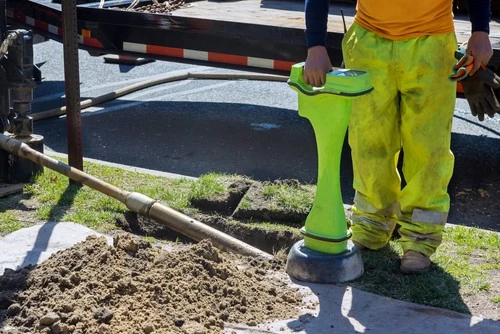
Pipe bursting replaces your old sewer line entirely. A bursting head is pulled through the existing pipe, fracturing it outward into the surrounding soil while simultaneously pulling a new HDPE pipe into place behind it. The old pipe is gone. What’s left is a seamless, continuous replacement pipe rated to last 50 to 100 years — no joints, no corrosion points, no gaps for tree roots to find their way back in.
Pipe lining works differently. Instead of replacing the old pipe, it rehabilitates it from the inside. A resin-saturated liner is inserted into the existing pipe, expanded to fit the interior walls, and cured in place — creating a new pipe within the old one. The host pipe stays in the ground; the liner becomes the new flow surface. Both methods require only minimal excavation compared to traditional digging, but they are not interchangeable.
Sewer Relining: When Lining Works and When It Doesn't
Sewer relining — also called CIPP lining, or cured-in-place pipe lining — has been used as a rehabilitation method for over 50 years. When conditions are right, it’s an efficient way to restore a sewer line without replacing it. The key phrase there is “when conditions are right.”
Lining works well when the host pipe is structurally intact enough to support the liner. If the pipe has cracks, minor root intrusion, deteriorating joints, or early-stage corrosion, lining can seal those defects and restore flow capacity without disturbing the surrounding soil. It’s a strong option for pipes that are aging but haven’t yet failed structurally.
Where lining runs into trouble is with pipes that are too far gone. Orangeburg pipe — the bituminized fiber pipe used extensively in Long Island homes built during the 1940s and 1950s — softens and deforms over time. It doesn’t hold a liner reliably. The same is true for pipes with collapsed sections, severe belly sections where the pipe dips and holds standing water, or pipes that have lost so much structural integrity that there’s nothing solid for the liner to bond to. In those cases, lining isn’t just the wrong choice — it’s a temporary fix on a pipe that’s already past saving.
One more thing worth knowing: lining always reduces the interior diameter of the pipe slightly. For most residential sewer laterals, this is a minor issue. But in older Long Island homes where the original lateral may already be undersized — four inches, in many cases — that reduction matters. It’s not a dealbreaker, but it’s a real consideration that should come up in any honest assessment.
The bottom line on lining: it’s a legitimate, long-lasting solution for the right pipe. It’s not the right solution for every pipe. A camera inspection before any recommendation is the only way to know which category yours falls into.
Pipe Bursting Sewer Line Replacement: When Full Replacement Is the Right Call
Pipe bursting sewer line replacement makes sense when the pipe itself — not just its condition — is the problem. If your home was built in the 1950s or 1960s, there’s a strong chance your sewer lateral is clay tile, cast iron, or Orangeburg. These materials were standard during the post-war suburban boom that built most of Nassau County and western Suffolk. They were installed with a design life of roughly 40 to 50 years. Most of them are now 65 to 80 years old.
Clay pipe is brittle and prone to cracking under ground movement. Its joints — the points where individual pipe sections meet — are exactly where tree roots enter. Long Island’s established neighborhoods are full of mature oaks and maples whose root systems have had decades to find those joints. Once roots establish themselves inside a clay pipe, the pipe’s structural integrity degrades quickly. Cast iron corrodes from the inside out, building up scale and eventually developing holes and cracks. Orangeburg softens, deforms, and collapses. None of these materials can be reliably lined once they’ve reached a certain point of deterioration.
Pipe bursting addresses all of this. It removes the failing material entirely and replaces it with HDPE — a seamless pipe with no joints for roots to enter, no interior surface for scale to build on, and no susceptibility to the ground movement that cracks clay. Because pipe bursting actually replaces the pipe rather than rehabilitating it, it’s also the only trenchless method that can upsize your lateral. If your current pipe is four inches and you want to replace it with a six-inch pipe, pipe bursting does that without excavation. Pipe lining cannot.
The process itself requires two small access pits — one for the bursting head entry, one for the winch pulling the new pipe through. There’s no continuous trench across your yard. Most residential jobs wrap up in a single day, and your property looks essentially the same when the crew leaves as it did when they arrived. That’s what homeowners in Bethpage, Bellmore, and Massapequa have been telling us for over 40 years.
When Traditional Excavation Is Actually the Right Answer
Trenchless methods are the right call in most situations — but not every situation. There are specific pipe conditions where excavation is genuinely the better approach, and any contractor who tells you otherwise is overselling their equipment.
If your pipe has a significant belly — a section where the pipe has sagged and now holds standing water — trenchless methods won’t fix it. Lining follows the existing pipe’s path, belly and all. Bursting replaces the pipe but follows the same grade unless the access pits are positioned to correct it. Correcting a belly usually requires opening the ground to reset the pipe’s slope. Excavation is also the appropriate choice when a pipe has fully collapsed in a way that prevents a bursting head from passing through, or when the site layout makes trenchless access impractical.
The important thing is that the recommendation comes from what your pipe actually needs — not from what a contractor happens to offer. That’s why we always start with a camera inspection.
How Do You Know Which Method Is Right for Your Sewer Line?
The honest answer is: you don’t know until someone runs a camera through the pipe. No contractor can give you a credible recommendation without seeing what’s actually underground. Anyone who quotes you a method before doing a camera inspection is guessing — and you’re the one who pays if they guess wrong.
A proper camera inspection gives you real information: the pipe material, the location and nature of any defects, whether there’s root intrusion or joint separation, whether the pipe has maintained its slope, and whether the structural condition supports lining or requires replacement. We show you the camera footage in real time during the inspection. You see exactly what we see — no mystery, no pressure, no recommendation you can’t verify.
This matters more on Long Island than it might elsewhere. The housing stock in Nassau County’s older communities — Levittown, Bethpage, Plainview, Farmingdale, Valley Stream — was built rapidly during a narrow window in the late 1940s through the 1960s. The pipe materials used during that era are now failing across the region at roughly the same time. That means a lot of homeowners are dealing with the same problem simultaneously, and a lot of contractors are busy. Busy contractors sometimes cut corners on diagnosis. A camera inspection before any recommendation isn’t optional — it’s the baseline for doing the job right.
We’ve been working under Long Island’s yards and driveways since 1980. We know the clay pipe under homes in Bethpage. We know the Orangeburg under houses in Levittown. We know what Long Island’s sandy glacial soil in southern Nassau does to pipe joints over time, and how the heavier soils in northern communities behave differently. That specific, accumulated knowledge shapes every recommendation we make — and it’s why our recommendations hold up.
What Does Pipe Bursting or Sewer Lining Actually Cost on Long Island?
Cost is one of the first questions homeowners ask, and it deserves a straight answer. The ranges below reflect real-world figures for residential sewer work — not promotional estimates.
Pipe bursting typically runs $150 to $300 per linear foot for residential sewer laterals. A full sewer line replacement via pipe bursting generally lands between $8,000 and $15,000 depending on the length of the run, access conditions, and any complications discovered during inspection. CIPP pipe lining tends to run slightly less — $125 to $200 per linear foot, with full-line projects typically ranging from $6,500 to $12,000.
Traditional excavation appears cheaper on paper at $150 to $250 per foot for the pipe work itself. But that number doesn’t include what gets destroyed in the process. Replacing a driveway on Long Island can cost $5,000 to $15,000 or more. Reseeding a lawn, rebuilding a retaining wall, repairing a sidewalk — those costs add up quickly. When you factor in full restoration, trenchless methods typically cost 30 to 50 percent less than excavation for the same job. On Long Island, where mature landscaping and paved driveways represent real investments, that math is especially significant.
There’s also the question of what happens if you delay. A lot of homeowners put this off — sometimes for years — because the cost feels overwhelming and the mess feels worse. We’ve heard that story many times, including from a homeowner in Bethpage who postponed for years worrying about his garage floor, his driveway, and his landscaping. The job ended up requiring one small excavation near the sidewalk. The pipe was replaced. The property was intact. The problem he’d been living with for years was gone in a day. Waiting doesn’t make the pipe better. It usually makes the eventual repair more complicated and more expensive.
One thing to ask any contractor before signing anything: is the quote all-in? Does it include permits, cleanup, and any surface restoration required? A transparent, itemized quote with no hidden add-ons is a basic quality signal. We pull all required permits, handle the documentation, and stand behind the work with a five-year guarantee on new alteration work and a two-year guarantee on new plumbing work.
Choosing the Right Sewer Repair Method Starts With an Honest Assessment
Pipe bursting, pipe lining, and excavation are all legitimate methods. The right one depends entirely on what’s happening inside your specific pipe — the material, the condition, the damage type, and the layout of your property. There is no universal answer, and any contractor who gives you one before running a camera is working from assumption, not information.
What you should expect from a qualified contractor: a camera inspection before any recommendation, a clear explanation of what they found and why they’re recommending what they’re recommending, a written quote that covers the full scope, and a warranty you can actually hold them to.
If you’re in Nassau or Suffolk County and you’ve been putting this off, or you’ve gotten conflicting advice and don’t know who to trust, we’ve been doing this work on Long Island since 1980. Reach out and we’ll start with the camera — so the recommendation we give you is one we can both stand behind.